On the occasion of the Fabrique de la Diplomatie, Stéphanie Ledoux, founder and CEO of Alcyconie, spoke at a roundtable dedicated to the democratic and sovereignty issues raised by artificial intelligence. A reflection that goes beyond mere technological and regulatory issues to question our collective ability to maintain control over our choices.
Led by Julien Nocetti, this roundtable also brought together representatives from the Interministerial Directorate for Digital Affairs (DINUM), the General Secretariat for Defense and National Security (SGDSN), and the CEO of AI Policy Lab.
As artificial intelligence gradually becomes part of our professional uses, access to information, and decision-making processes, a fundamental question arises: how can we take advantage of these technologies without compromising the very conditions of our democratic autonomy?
reflections led by Stéphanie Ledoux.
Digital sovereignty: the real challenge is to preserve our freedom of choice
Digital sovereignty is often approached from the perspective of infrastructure location, supplier nationality, or mastery of strategic technologies.
These dimensions are essential, but they are not enough.
As European organizations become dependent on a few players for their cloud infrastructures, computing capabilities, and now their artificial intelligence models, the risk goes beyond the economic dimension alone.
An organization, such as a state, can legally retain its freedom of decision while gradually losing the technological means to exercise it.
The distinction between interdependence and dependence takes on its full meaning here. In an open economy, interdependencies are inevitable. They become problematic when they no longer leave a credible alternative.
Interoperability, reversibility, data portability, and technological pluralism therefore constitute issues of sovereignty in their own right.
As Stéphanie Ledoux pointed out:
“Sovereignty is not about doing everything yourself. It means remaining free to choose. »
Disinformation: what if the main danger was no longer believing in the truth?
Generative artificial intelligence is profoundly transforming the mechanisms of information production and dissemination.
The democratization of synthetic content, the multiplication of deepfakes, and the automation of influencer campaigns raise legitimate concerns. But the democratic risk could be even deeper.
Because while everything can now be fabricated, everything can also be challenged.
An authentic video can be presented as a deepfake. A real recording can be denounced as manipulation. The very existence of these technologies offers new possibilities to challenge facts that are nevertheless established.
“The ultimate danger may not be that we believe in falsehood: it is that we no longer believe in the truth.”
This evolution is taking place in an already fragile informational environment, where artificial intelligence is gradually becoming an intermediary between citizens and information.
By selecting, synthesizing, and personalizing content, these systems could contribute to further fragmenting our perception of reality.
However, a democracy does not require its citizens to share the same opinions. On the contrary, it requires that they be able to debate based on a minimal foundation of common facts.
Preserving this shared informational space, the plurality of sources, and everyone’s ability to access verifiable information is therefore a major democratic challenge.
Cognitive resilience: preserving our ability to think without AI
Beyond infrastructure and information, the rise of artificial intelligence raises a third, perhaps less debated, question: that of our intellectual autonomy.
We rightly question the consequences of social networks and the attention economy, especially for the youngest. But what collective reflection are we conducting on the growing delegation of our cognitive abilities to artificial intelligence?
When does assistance become substitution? What are the long-term consequences when we gradually delegate writing, analysis, memorization, or reasoning to automated systems?
These questions are not a plea against innovation. They invite us to look beyond immediate productivity gains to consider the profound transformations these technologies could bring.
“For a democracy to survive AI, its citizens must first continue to know how to think without it.”
This conviction directly aligns with the resilience issues to which Alcyconie dedicates its work.
Because resilience is not just about having high-performance technologies or protective devices. It also relies on the ability of individuals and organizations to maintain their discernment, autonomy, and ability to act when their usual environments are disrupted.
In an economy that values continuous optimization, this sometimes means preserving alternatives, human skills, and redundancies whose usefulness is not measured solely by their immediate effectiveness.
Governing artificial intelligence also means organizing checks
These issues call for artificial intelligence governance that cannot rely solely on technological actors.
Regulation is essential, but it must be accompanied by an independent capacity to understand, evaluate, and question deployed systems.
State, research, industry, media, education, and civil society each have a role to play. No actor should be able to develop a technology alone, assess its risks, and determine the limits of its use.
More broadly, the reflection on artificial intelligence cannot be limited to an opposition between innovation and regulation. It must integrate the economic, social, cognitive, and democratic consequences of its deployment.
The question is therefore not only how far artificial intelligence will allow us to go, but to determine what we collectively want to continue mastering.
A question that goes far beyond technology and places resilience, sovereignty, and decision-making capacity at the heart of strategic choices in the coming years.
Read the article
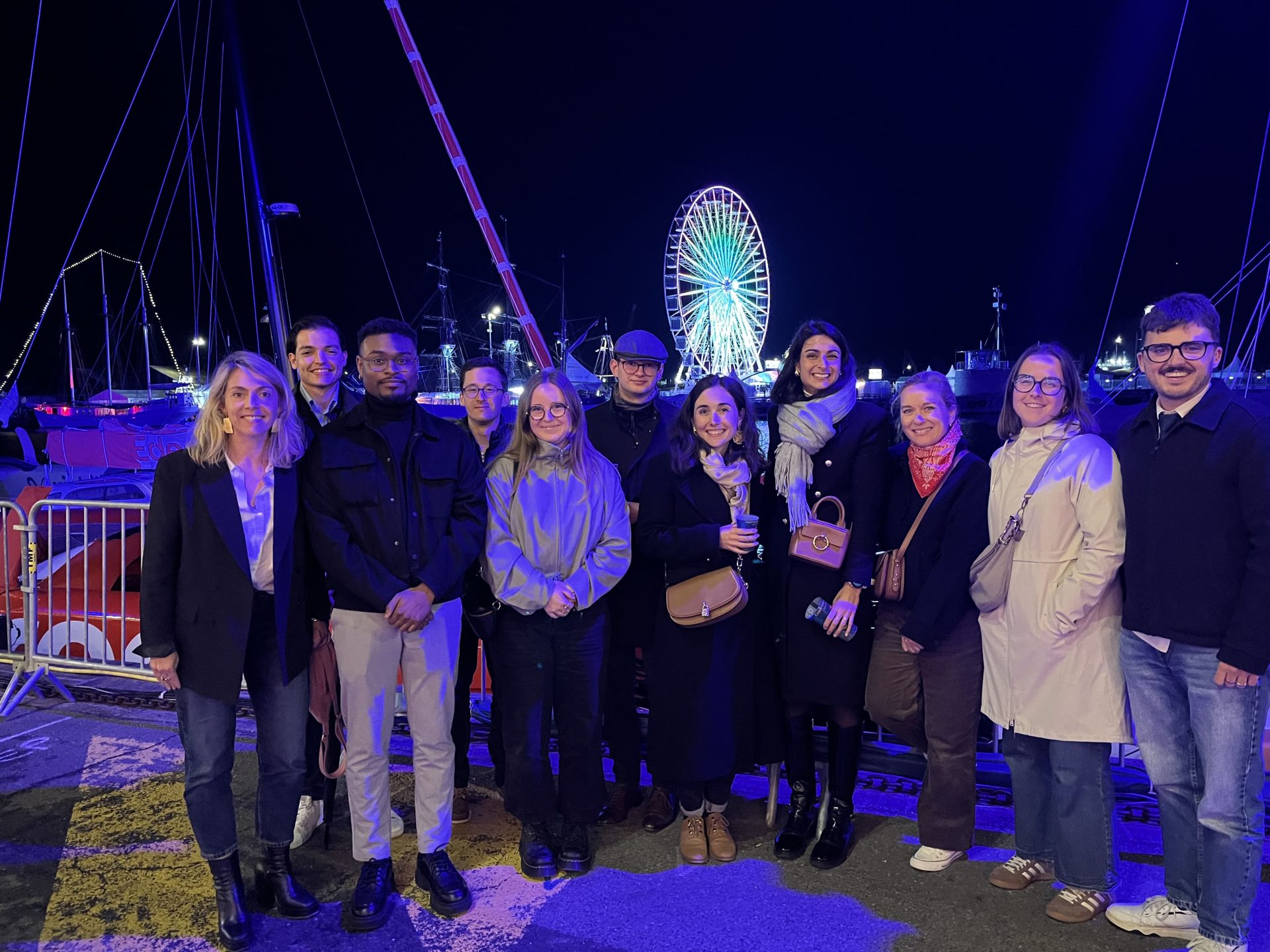
⛵ Route du Rhum: the Alcyconie crew meets in Saint-Malo!
5 November 2026Read the article

[PODCAST] Guillaume Chéreau looks back on the early days of cyber crisis management in France
27 October 2026Read the article