


Alcyconie recently took part in a strategic mission to Brussels
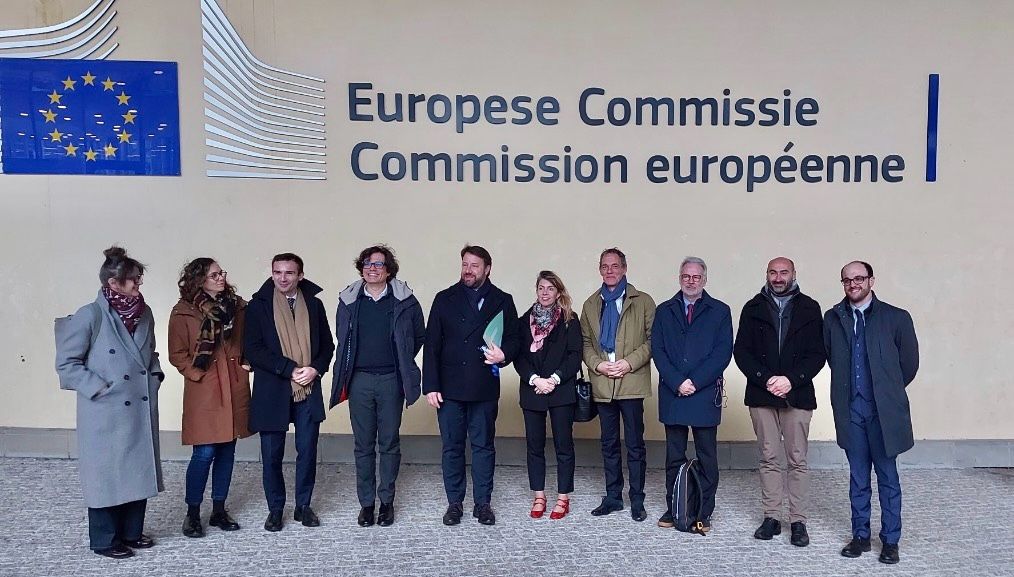
Alcyconie recently took part in a strategic mission to Brussels, led by Loïg Chesnais-Girard, President of the Brittany Region, and Jérôme Très-Hardy, regional elected official, alongside a delegation bringing together the Cyber Cluster of Excellence, Bretagne Cyber Alliance, as well as several major players in the French cyber sector: Sekoia.io, DIATEAM, Almond and Wallack.
This mission had a clear objective: to bring the voice of Breton cybersecurity companies as close as possible to the European institutions, where the regulatory, industrial and strategic frameworks that will shape the future of the sector in the long term are being built.
During these two days, the delegation was able to exchange with many key interlocutors: DG DEFIS, DG CONNECT – in particular with Despina Spanou, the IA office, DG Employment, the French Representation to NATO and the office of the European Commissioner for Defence.
Direct and in-depth exchanges, marked by a real listening to operational realities, field constraints and alerts issued by companies.
The key messages conveyed by Alcyconie
On this occasion, Alcyconie defended several structuring issues for the emergence of a robust and credible European cyber sector.
First of all, the European regulatory asymmetry: developing a cyber company in Europe does not mean conquering a single market, but evolving in a fragmented landscape, made up of 27 distinct national frameworks. Where regulation could become a powerful lever for competitiveness and scaling-up, it is still too often a brake on development.
Secondly, cognitive issues in the era of hybrid conflicts: beyond infrastructures and information systems, cognitive capacities – both individual and collective – are now a field of confrontation in their own right. The question is no longer whether Europe is concerned, but how it equips itself with a strategic response to these forms of silent infiltration.
Alcyconie also stressed the need for European reference catalogues, on the model of OURANOS, in order to facilitate and accelerate the use of European solutions, by strengthening the visibility and legibility of the existing offer.
Another key point is the European recognition of qualifications and certifications, which is essential to build trust, support the rise in maturity of players and allow a real transition to scale up on a continental scale.
Finally, the use of artificial intelligence was the subject of a clear message: the challenge is not to slow down innovation, but to promote a regulated and controlled use of AI, in order to avoid the creation of new organizational vulnerabilities — and a lasting weakening of our cognitive capacities.
A decisive moment for Europe
This Brussels sequence was a powerful reminder that cybersecurity is no longer just a technical subject. It is now at the crossroads of major economic, industrial, strategic, cognitive and political issues.
A unique momentum is opening up for Europe.
The question is no longer whether to structure a strong, credible and sovereign European cyber sector, but to act now. The decisions taken today will have a lasting impact on our collective ability to protect our organizations, support innovation, and preserve our strategic autonomy.
It is on this condition that Europe will be able to transform its ambitions into real capabilities – and make cybersecurity a real lever of power and resilience.
Read the article

Stéphanie Ledoux, Alcyconie: a cyber crisis management privateer - LeMagIT
10 February 2026Read the article
Cyber crises: the psychological impacts of cyberattacks on employees: an invisible challenge for organisations
22 January 2026Read the article