



Article written by Sylvaine Luckx for LeMagIT.
“It’s when we accept the crisis that we can start to solve it”
Behind Stéphanie Ledoux’s youthful smile hides a soul of tempered steel. That of a woman who, for years, has made crisis management not only a professional path, but also a passion.
Stéphanie Ledoux’s handshake is firm; His gaze, very direct. Under her smooth, composed appearance, you quickly feel a well-forged soul and character, which leave little room for questions and doubt. This is better when dealing with subjects as complex as crisis management in a sensitive environment, especially cyber.
A native of Saint-Malo by roots and heart, Stéphanie Ledoux chose, after many years, to establish her professional life and her life in the corsair city, and to regularly forge her temperament by running along the ramparts and taking a few invigorating swims on the Plage du Sillon. But we are not there yet…
The young woman began with schooling largely in Germany, “because my mother was passionate about Germany. So I did a German course in college, and I wanted to continue my studies in Germany.” In 2005, she completed a Bachelor’s degree in commerce and business at the FH of Münster, with a double degree from the FH Münster and ESC Bordeaux.
The young woman felt at ease there, and began her career with a first professional experience at Airbus, then Lufthansa, as head of press relations for the Africa, Near and Middle East region. This is enough to prepare her weapons as a negotiator and crisis management, knowing the exposure of the aviation sector in an area whose geopolitical sensitivity for decades is no longer to be proven.
She then joined the SNCF as a digital communication officer. A sensitive position, which she developed before arriving at Thalys in Brussels in January 2007. She climbed the ladder and in January 2012 became head of the cross-functional and strategic projects department. A good progression.
“It’s no longer the hierarchy that counts, but the desire to resolve the crisis and get back on track”
Stéphanie Ledoux, CEO – Alcyconie
It was at Thalys that she had the opportunity to manage her first “real” large-scale crisis: the derailment of a train in February 2010 in Buizingen. The experience is striking. “Not only did we have to reorganise the rail network, but also, and above all, manage the human consequences of a tragedy internally and externally. In a few hours, we had to manage thousands of passengers and interrupted rail traffic on the entire northern axis for nearly 2 weeks in parallel with heavy human consequences,” explains Stéphanie Ledoux. “I’ve seen how people can behave in a crisis situation, pushed to their limits and in a traumatic situation that they don’t control at first. I have seen ruptures, but sometimes also an extraordinary momentum with teams united to get the machine going again, where it is no longer the hierarchy that counts, but the desire to resolve the crisis and get back on track. On a human level, I learned a lot… even though I hardly slept during that time,” she says with a smile.
“It’s when we accept the crisis that we can start to solve it”
Stéphanie Ledoux, CEO – Alcyconie
She draws a few lessons from this that she applies to crisis management: “Before wanting to solve it, integrating it and accepting the idea that, yes, it happens, and that it is happening, that nothing is normal, that all the usual points of reference are shattered, is undoubtedly fundamental in the management of a crisis. Trying to manage a crisis that you haven’t taken the time to accept and integrate is counterproductive,” she explains. “Of course, at the beginning, there are situations of refusal, denial, it’s normal. But it’s from the moment we accept it, that we can start working on it and fixing it,” she explains.
The young woman also needs to rub shoulders with other experiences that are just as structuring in her reflection on crisis management. Stéphanie Ledoux embarked as a humanitarian worker for more than a year, from 2015 to 2016. She works on the “coordination of medical camps in the bush for villagers and care for children with special needs (paraplegic, autistic), with local and European doctors and physiotherapists and support for the management of an orphanage in India in Orisha”, she details on her LinkedIn profile, with missions in Africa (in Benin) in Madagascar, in India.
“It’s a job where you don’t pretend”
Stéphanie Ledoux, CEO – Alcyconie
But why does crisis management attract her so much, she who seems so serene? It is difficult to answer this question ex abrupto… Stéphanie takes the time to think: “It’s a job in which you don’t pretend, you can’t cheat. It’s a job of passion. You can’t improvise yourself as a crisis manager; we become one. What fascinates me, every day, in every crisis, is to see the unsuspected resources of the team members. It is the ability of the collective to move forward in uncertainty, in the same direction to ensure the maintenance of activities and the return to normality.”
The fact of seeing human beings go beyond their limits to solve a situation, and accompany them in these pivotal stages, is undoubtedly part of her driving force, even if she does not recognize herself at all in the image of the savior of extreme situations. It’s a cliché for her. “Knowing how to solve a crisis is above all about having apprehended it,” she stresses. Training and preparation are at the heart of crisis management processes. Even if we will never be fully prepared for all scenarios.
In 2018, she completed an MBA in Cybersecurity, International Security and Risk Management at the École de Guerre Économique, with the aim of “training in the challenges of cyber and economic warfare to have the material necessary to adapt [her] expertise to cyber crises”.
During the winter of 2016, she was recruited by the Roullier group as Director of Group Communications in her home country of Saint-Malo. The Roullier Group is one of the major Breton agri-food groups, with 109 industrial units and more than 10,000 employees. Founded in 1959 in Saint-Malo, it has a turnover of several billion euros, 74% of which is exported. For the young woman, this position – particularly strategic and exposed – was supposed to be the Holy Grail.
“When you get there, you feel really useful”
Stéphanie Ledoux, CEO – Alcyconie
But crisis management has become his DNA, his passion, his life, as well as the desire to undertake in the place of his roots. In November 2018, she founded Alcyconie, whose name, derived from the adjective Alcyonian (the Alcyonian calm, the calm in the middle of the storm), specialises in cyber crisis management. Why cyber? “Because cyber is at the heart of contemporary issues: geopolitics, disinformation, freedom, the stability of our states and our strategic companies,” says Stéphanie Ledoux.
Around a small team that brings with it, depending on the mission, profiles of specialists in different fields, she anchors her brand behind the ramparts of the Corsair city and makes Alcyconia a reference in the field in 6 years. With the same conviction: “a cyber crisis is above all a crisis, with its markers; Refusal, denial, panic, disorganization… To accept it and to prepare for it is to a large extent to solve it. And when you get there, you feel really useful.”
Article written by Sylvaine Luckx for LeMagIT.
Read the article
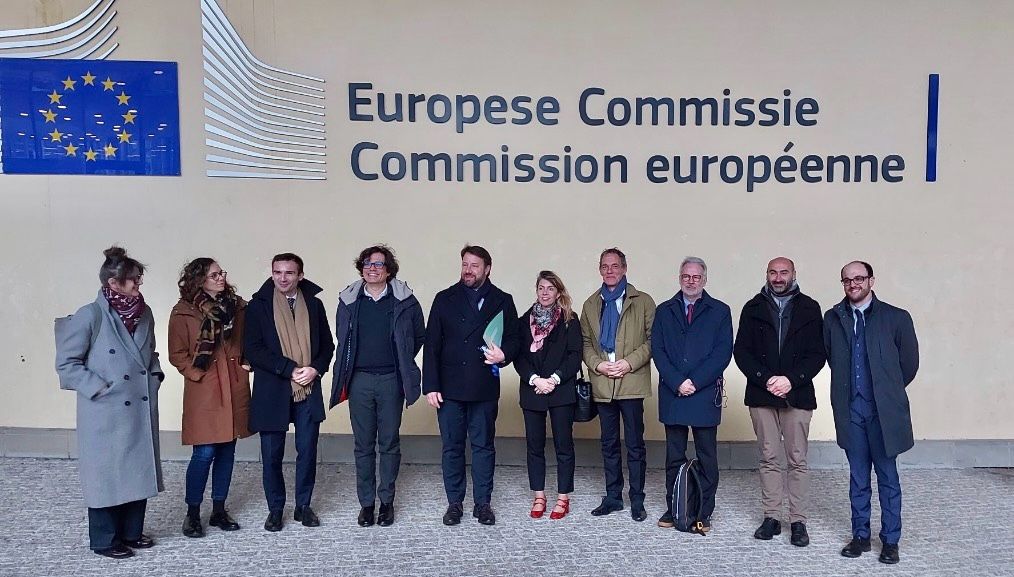
Mission to Brussels: bringing the voice of Breton cybersecurity to the heart of the European institutions
31 January 2026Read the article

Cyber crises: the psychological impacts of cyberattacks on employees: an invisible challenge for organisations
22 January 2026Read the article