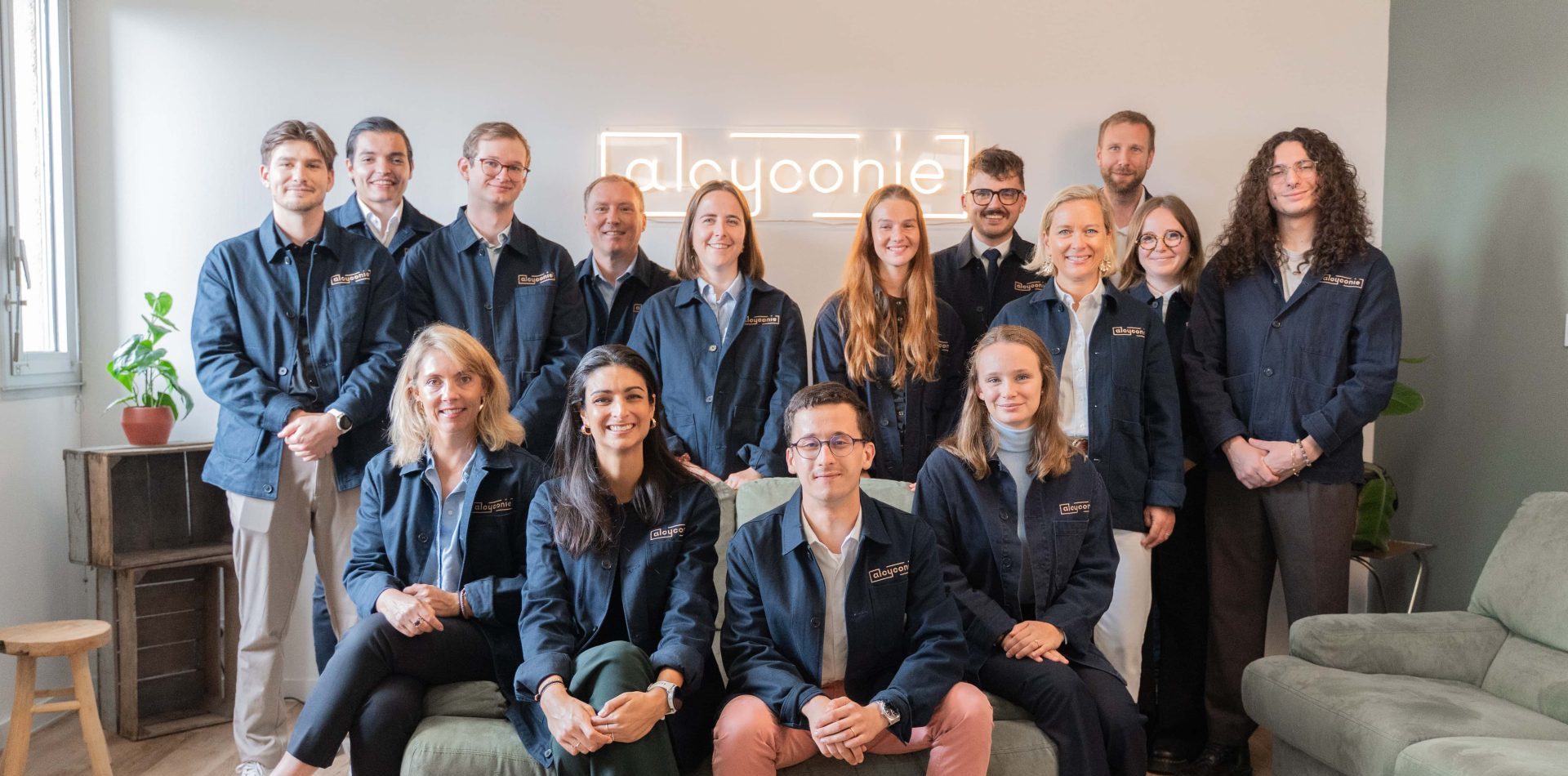
Industry, defense, cyber: Europe faces the return of power politics. This is the question that Raphaël Glucksmann, Member of the European Parliament, Loïg Chesnais-Girard, President of the Brittany Region, Vidal Teixeira, President of Seaber, and Stéphanie Ledoux, founder and CEO of Alcyconie, debated at the Breton Economic Forum 2026.
In a world marked by hardening geopolitical power struggles, technological acceleration and the multiplication of strategic dependencies, one question ran through the discussions: how can France and Europe regain the means of their power and their freedom of action?
Regaining the means of European power
Faced with the return of power politics, Raphaël Glucksmann argued for the need to strengthen European strategic autonomy and to reduce the dependencies that weaken our collective capacity to act.
An ambition that goes beyond the military question alone: it raises questions about our industrial sovereignty, our control of critical technologies and our ability to defend our interests in an increasingly competitive international environment.
The discussions thus brought out a shared observation: European power cannot be built without regaining control of our economic, technological and strategic dependencies.
“Without control, power is nothing”
Building on this reflection, Stéphanie Ledoux defended a strong conviction: power only has meaning if it goes hand in hand with genuine control.
Control of our technologies, our infrastructure, our dependencies, but also of our capacity to set our own strategic direction.
At a time when artificial intelligence is profoundly transforming our economies and societies, this question takes on a new dimension. Sovereignty is not only about having industrial or technological capabilities. It requires preserving the freedom to choose, to weigh trade-offs and to decide.
Cognitive autonomy, a democratic issue
Beyond material and technological dependencies, Stéphanie Ledoux also called for recognizing another form of vulnerability: the erosion of our cognitive autonomy.
“It is by protecting our cognitive capacity that we will ultimately protect our democracy. If we no longer think, we are no longer a democracy.”
In an information environment profoundly transformed by artificial intelligence, influence strategies and the increasing automation of decision-making processes, preserving our ability to think for ourselves becomes a sovereignty issue in its own right.
Because the deepest dependency may not be the one that prevents us from acting, but the one that ends up depriving us of our ability to think and decide freely.
From power to resilience: preserving our freedom of action
These issues of control and autonomy resonate directly with the challenges organizations face.
In the face of cyber, digital and hybrid crises, resilience is not only about absorbing a shock or restoring operations. It also relies on the ability to anticipate disruptions, understand interdependencies and preserve the conditions for informed decision-making, even amid uncertainty.
A conviction at the heart of Alcyconie’s approach: preparing organizations for uncertainty so they can retain, even in the most critical situations, their ability to decide and act.
Below, watch the video (in French) of this Breton Economic Forum 2026 panel discussion on the conditions for a European power capable of defending its interests, controlling its dependencies and preserving its freedom of action.
Read the article
[PODCAST] Guillaume Chéreau looks back on the early days of cyber crisis management in France
27 October 2026Read the article
Alcyconie at ECW from 16 to 19 November in Rennes
21 October 2026Read the article